
Qatar’s Exchange Sector Enters a New Phase of Maturity
In an interview published on page 14 of Al Sharq Al Iqtisadi on Wednesday, 5 August 2026, Dr. Mohamed Mousa, Deputy Chief Executive Officer of Al Dar for Exchange Works, spoke with journalist Sayed Mohamed about the forces reshaping Qatar’s exchange industry — and about the market infrastructure that, in his view, deserves the credit.
His central argument: the sector’s resilience is not the achievement of any single operator. It is the product of four strategic initiatives led by Qatar’s regulators and market institutions, which together have given exchange companies a modern rail network to build on.
“The strength of the local exchange market today is a regulatory achievement before it is a commercial one. Our job as operators is to build well on the foundations that have been laid for us.”
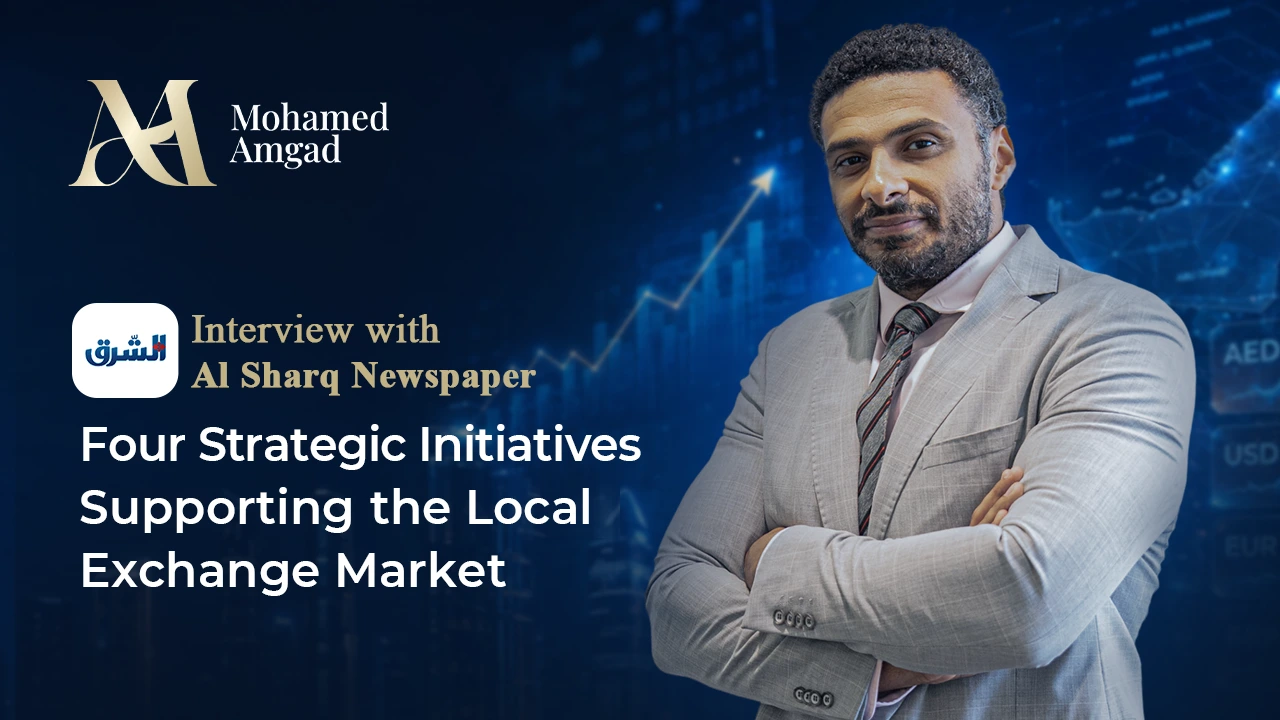
The Four Initiatives Supporting the Local Exchange Market
Dr. Mousa was explicit that these initiatives are sector-level — driven by the Qatar Central Bank, the national payments infrastructure and the Qatar Financial Centre — rather than programmes belonging to any one exchange house.
1️⃣ The Qatar Central Bank Digital Transformation Strategy
QCB’s digital transformation agenda has moved the exchange sector from paper-based, branch-bound processes toward digitally native onboarding, screening and settlement. For exchange companies, this has compressed transaction times, lowered the cost of compliance per transaction, and made round-the-clock service commercially viable.
2️⃣ Qatar Mobile Payments, Instant Payments and E-Wallets
The build-out of instant payment rails and licensed e-wallet services has changed customer expectations permanently. Value now moves in seconds rather than hours, and the wallet has become a legitimate front door to remittance and currency services — particularly for Qatar’s expatriate workforce.
3️⃣ The QFC-Led FinTech Ecosystem
The Qatar Financial Centre’s work in attracting and licensing FinTech firms has created a partnership market that did not exist a decade ago. Established exchange companies can now source technology, compliance tooling and distribution from a domestic ecosystem instead of importing every capability.
4️⃣ Evolving Regulatory and Risk Frameworks
Continuous refinement of AML/CFT rules, risk governance standards and supervisory expectations has, Dr. Mousa argued, raised the sector’s credibility with international correspondents. Stronger frameworks make Qatari exchange houses easier to bank — which in turn protects corridor access for customers.
“Regulation is often described as a cost. In our sector it is closer to market access. Institutions that meet the standard keep their corridors open.”
What the Sector Numbers Show
Citing Qatar Central Bank reporting, Dr. Mousa set out the shape of the market:
- 7.4% growth in the value of transfers executed through exchange companies in 2025 — a moderation from the 9.9% recorded in 2024, and, in his reading, a sign of normalisation rather than weakness.
- Corridor concentration: roughly 73% of outbound transfers were directed to Asian markets, 16.5% to Arab countries, and approximately 10.5% to the rest of the world.
- Sector assets rose 8.1% to QAR 2.65 billion — an increase of around QAR 200 million — growth driven principally by bank balances, which he read as evidence of stronger liquidity discipline across the industry.
The corridor mix, he noted, is the single most important structural fact about the Qatari market: a sector where nearly three-quarters of volume flows to Asia is a sector whose economics are set by remittance behaviour, not by tourism or trade finance.
Al Dar Exchange: H1 2026 Performance
Turning to his own institution, Dr. Mousa reported that Al Dar’s service revenues reached QAR 43.72 million in the first half of 2026, against QAR 40.26 million in the comparable period — growth of 8.6%.
The composition of that growth is as notable as the headline:
- Transfer revenues rose from QAR 16.41 million to QAR 19.49 million, an increase of roughly 18.8% — the clear engine of the half.
- Foreign exchange transactions totalled 226,500 in H1 2026, split between 145,700 sell and 80,900 buy transactions.
- Foreign exchange revenues eased from QAR 8.24 million to QAR 7.47 million, reflecting tighter spreads and a more competitive currency market.
Dr. Mousa did not present the FX softening as a setback. The shift, he suggested, reflects a deliberate rebalancing: transfers and digital services now carry the business, while currency exchange operates in a market where margin compression is a structural reality across the region.
“We treat 2025 as a launchpad, not a finish line. The half-year numbers tell us the direction is right.”
Strategic Priorities Ahead
Framing 2025 as a launchpad for the next phase of expansion, Dr. Mousa outlined four priorities guiding Al Dar Exchange:
- Digital transformation — continuing to move service delivery onto digital and self-service channels.
- Electronic financial services — deepening the wallet, app and instant-payment layer of the business.
- FinTech partnerships — working with the domestic and regional FinTech ecosystem rather than building every capability in-house.
- Compliance and governance — treating regulatory strength as a competitive asset and a precondition for international correspondent relationships.
A Regulator-First Reading of the Market
What distinguishes this interview from much sector commentary is where Dr. Mousa places the credit. Asked to explain the exchange industry’s stability, he pointed consistently to the regulator and to national market infrastructure — not to his own institution’s initiatives.
It is a reading consistent with his broader body of work on FinTech transformation across the GCC: that durable innovation depends on rails, rules and trust being built first, and that operators succeed to the extent they build responsibly on top of them.
About Dr. Mohamed Mousa
Dr. Mohamed Mousa is the Deputy CEO of Al Dar Exchange in Qatar, a FinTech practitioner and an academic researcher specialising in Islamic finance and financial technology transformation. With more than 15 years in financial operations and over a decade as a FinTech strategist, he has led the launch of Qatar’s first FinTech mobile application and its first self-service kiosk network, and is a recurring commentator on the Gulf’s digital finance transition.
Connect with Dr. Mousa on LinkedIn for more insights into his work.
Media Contact
For interviews, features, or speaking requests:
📧 info@mohamedamgad.com
📰 Publication: Al Sharq Al Iqtisadi — page 14, Wednesday 5 August 2026 (interview by Sayed Mohamed)
📥 Download Press Kit: Dr. Mohamed Amgad Mousa – Media Profile PDF