
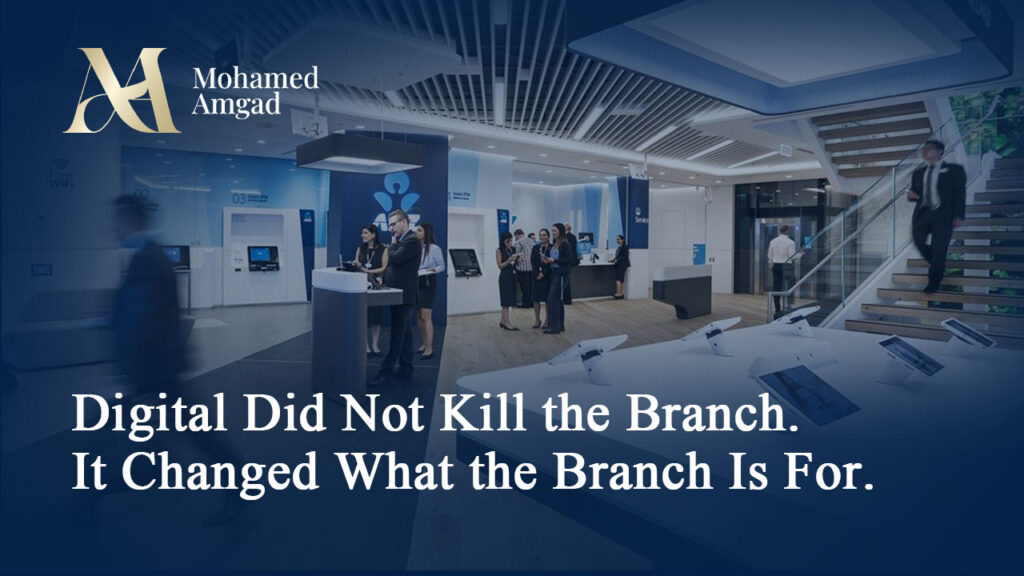
For roughly fifteen years, a confident prediction has circulated: physical service points in financial services are finished, and it is only a matter of time.
The prediction has been partly right and mostly wrong, in an instructive way.
What has actually happened is that the routine left the branch. Balance checks, standard transfers, simple queries — these migrated to screens, permanently and correctly. Nobody wants to travel and queue for something a phone does in twenty seconds.
But the branch did not empty. Its composition changed. What remains is the complicated, the high-value, the unfamiliar, and the reassurance-seeking. Which means the physical service point is now handling a harder mix of interactions than it was before.
The mistake this creates
Many organisations responded to falling footfall by reducing branch investment — fewer staff, less training, less authority at the counter.
That is precisely backwards. If the simple work has left and the difficult work remains, the person at the counter needs more capability, not less. They are no longer processing transactions. They are handling exceptions, explaining unfamiliar products, and resolving situations that a digital channel could not.
Under-resourcing that role produces the worst of both worlds: a channel expensive to maintain and no longer good at the only thing it is still uniquely useful for.
Customers do not think in channels
We organise ourselves into digital teams and branch teams, with separate budgets, targets, and reporting lines. Customers experience none of that. They start something on an app, call about it, and finish it in person — and they reasonably expect all three to know what happened.
When they have to re-explain their situation at each step, they do not conclude that our systems are poorly integrated. They conclude that we are not paying attention.
The organisational fix is harder than the technical one. Shared visibility of the customer’s history is a solvable engineering problem. Getting teams with separate incentives to own a shared outcome is a management problem, and it is where most omnichannel efforts stall.
What each channel is actually good at
It helps to be explicit rather than assuming everything should be everywhere.
Digital does well with: routine and repeat transactions, status and information, anything a customer wants to do at an inconvenient hour, anything they would rather do without speaking to a person.
Human channels do well with: first-time complexity, situations that have already gone wrong, decisions where the customer wants reassurance from another person, anything where the customer’s actual need differs from what they initially asked for.
That last one is underrated. A skilled person notices when the stated question is not the real one. No interface does that yet.
The design principle
The goal is not to push everyone to the cheapest channel. It is to make sure each interaction happens where it is most likely to end well — and to make the handover between channels invisible when it needs to move.
Customers are not looking for digital or physical. They are looking for resolution. Whichever route delivers it fastest is the right one, and our internal organisational chart is not their problem to solve.
Dr. Mohamed Mousa writes about financial services, technology, and leadership.